Showing posts with label events. Show all posts

Punk Science

Last term Sarah organised a trip to a "dialogue" event at the Dana Centre. I thought we could do something similar this term. Except this time, to see people aiming more to entertain than engage.

The "Punk Science" boys will be performing on the 27th Feb. They've been doing shows at Dana since it opened, and have even taken them to the Edinburgh Festival. The Metro said “Laugh as you learn” and the British Council sent them on a tour of Malta. There's more information about them here and a review of one of their older shows (by a Imperial College student) here.

They tend to sell out fast, so if you are interested email me, and I'll see about getting tickets.

ucl seminars

UCL's Science and Technology Studies seminars this term. The one on the 26th Feb might be relevant to this course.

Play event at Dana

Last night a few of us went to the Dana Centre for a "PEST" type event (on play and learning).

The event eschewed the traditional set up of speakers giving presentations followed by questions. Instead, four speakers gave short (3 min) introductions of themselves. We were then sorted into groups, so you'd not necessarily be with people you know.

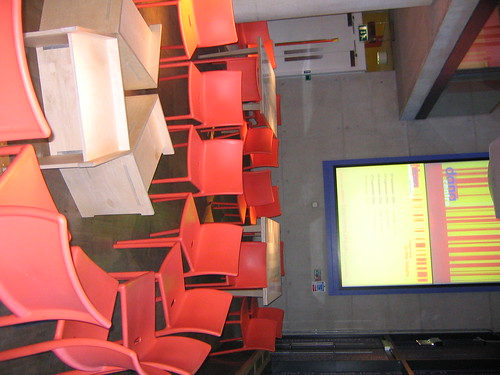
Each group was timetabled 10 mins with each speaker. The speakers sat in a circle of chairs and when we joined them we were just expected to talk. Some speakers gave a lead in, some just said "so, what you want to talk about". At the end of the night the groups joined together again and the speakers made a sum up comment. There was the opportunity to for the debate to continue, although no one took it up.

There was a whiff of speed-dating about the process.

Personally, I thought it worked better than I imagined it was going to. Conversation was quite stilted at the start, but by the end people had relaxed into it. A little at least, there was never a huge amount of energy in the room. Moreover, I worry the set-up of letting the audience talk as much as possible favours those who come with previously formed views on a topic. One problem might just be that audiences aren't used to acting like that - several people had come along armed with notebooks.

playing to learn...

...is the Dana event some of us will be attending next Thursday (the 7th). Check out this web-page for further details of the topic and the speakers.

A couple of things that struck me from the info given: the event is supported (i.e. paid for) by Nintendo, and the panellists are all 'experts' of one kind or another (academics, policy types). It will be interesting to hear the voices of the 'public' from the audience. Is there anyone else that you think should be given a voice in the debate?

lecture list

This listing could be useful for finding science communication events.

Class 7: PUS vs. PEST

Two weeks ago we discussed the deficit model and the critical authors who argued that it was an inaccurate picture of the public. This week we talked about the effects knowing this will have on our communication.

Once we acknowledge that science's publics are active and knowledgable, how we communicate needs to take this into account. A one-way flow of scientific 'facts' isn't acceptable any more: we now need to 'engage' people with science and technology. Communication is dialogic, interactive and public-led; using anything from market research to public debates to tailor each communication to its audience and to produce a 'dialogue' between science and the public. We have moved from the Public Understanding of Science to Public Engagement with Science and Technology.

We talked - and you planned - some examples of this new kind of sci-comm: from theatre to interactive computer programmes to model bridge-building or using public nature surveys. Creativity is key, as is remembering your audience.

This week's set reading (now on WebCT, albeit it as an upside pdf) gives some more examples of what one museum thinks of 'dialogue'. Today's powerpoint is also up there, as is next week's reading from a Demos paper (in full - you only need to read the first chapter), which starts us thinking a bit more about what 'dialogue' really is or should be.

And don't forget I have a couple more tickets for the Dana event on Thursday 7th Dec; you need to let me know asap if you want one.

public engagement with medical genetics

It's easy to forget, when we just look at examples of science communication, that there is an academic field focussing on the interactions between science and its publics. People do the kind of ethnographic work that Bruno Latour did on public engagement with science. (As well as Alice and mine's weird and wonderful research.) We run a research seminar to showcase some of this research - from inside and outside the SCG. This Wednesday Dr Alex Plows is coming along to talk: if anyone is interested let me know and I can give you the room details. Her seminar abstract is below...

"Snap-shotting" public engagement with medical genetics (genomics): overview of key findings and issues

The talk will feedback the findings of a 3 year research project 'the emerging politics of human genetic technologies' - ethnographic/ qualitative research - see www.lancs.ac.uk/fss/cesagen/politics/

Medical genetics (genomics) is a broad, complex and rapidly developing field comprising many different (potential) applications- biobanking, genetic testing, etc. Multiple publics are engaging with medical genetics in many different ways. This talk will provide an overview of key "prime mover" groups and networks, identifying key issues and core frames. A core finding is that to construct any actor group as simply "pro" or "anti" biotechnology fails to map the sophistication, range, context- dependency, and cultural and political situated-ness, of actor responses (see Irwin and Wynne 1996, Wynne 1995, Bauer and Gaskell 2003).

dana centre trip mark 2

Okay, so the event on the 22nd I was hoping we could go to is sold out. So I have booked some tickets for the one on Thursday 7th December - they still have some left for this. And appropriately enough, given our recent discussions on the impact of video games, it's called Playing to Learn and is about video games in education. It'll be interesting to see what models of audiences are used and assumed: is learning (if it happens at all) passive or active? Victims or instigators?

Email me for a ticket: but be warned, I only have a limited number. If I run out there may still be some left via the Dana ticket office.

dana centre trip

This course normally runs at least one trip to somewhere exciting (previous years have gone to the theatre and the Science Museum). Given that we'll be talking about interactive and dialogue-based science communication in the next couple of weeks, I thought it would be good to pay a visit to what is - for better or worse - one of the foremost sites of this in the UK, the Science Museum's Dana Centre. This is free and right next door to Imperial, so you can pop in any time to one of their evening events (although you need to remember to book). An event might also be a good thing to blog about - it's a relatively new form of sci-comm and I think there would be a lot of interesting things to say.

But a group visit might be useful as well - we'll all be talking about the same thing then. So I'm going to go along to the event on Wednesday 22nd November, 'The Learning Brain'. The event - about lifelong learning and the brain - looks pretty interesting and, as this is a subject area which there may well be lay expertise in, will give us a chance to look at how good places like Dana are at incorporating this. Plus there's a good cafe-bar. If you want to come along, email me before this Friday, the 10th and I'll book for a group of us to go.

And if anyone has any good ideas for other trips, let us know.