Showing posts with label class summary. Show all posts

class 20: revision

Sarah started this class by writing up a blank timeline: 1985 at one end of the whiteboard, 2007 at the other. She asked the class to tell her where major developments in science communication would go within it. PUS, and events such as the Bodmer report ended up at one end, with PEST at the other. You might find the overview on this page a neat summary.

I then tried to synthesise some of the rest of term one in reference to a sightly 'sensational' story on bird flu. To quote Gregory and Miller on this topic:

sensationalism and gee-whizzary... [is] not a punishment inflicted on science stories by disdainful or malicious journalists. It arises in science journalism because of the rhetorical conventions of popularization (Gregory & Miller, 1998, 116-7)
This points us towards thinking about news values, and other contextual differences between the cultures producing news language and those constructing scientific discourse. It's also worth thinking about the specific context of the issue covered - are stories on MMR a different case from 'Climate Porn'?

In some ways linked to this, I also discussed questions around science and fiction. I went through the opinions of a variety of thinkers on the topic (e.g. Russell Stannard, Joan Solomon, Rosalind Haynes) and emphasised that students should take a developed approach to considering audience effects (an issue which is worth keeping in mind across the course)

Sarah then put some of term two together, by considering each of the specific media we've looked at.
She asked the class to list specific issues relating to these media, and what topics (such as boundary work, structure, interactivity, etc) might be an issue across them.

class 19: education

Firstly, thanks for all your essays - we'll get them back to you as soon as we can. I look forward to reading them.

This session acted partly as an introduction to the topic of school-science, but also as a revision of key issues in the history of thought on the Public Understanding of Science, which is important as we approach the exam.

We discussed the introduction of this new GCSE, and the general movement in school-science to build a curriculum based on what "everybody needs to know" rather than just what people training to be scientists should learn. A move away from training and towards PUS, or thinking about science "consumers" rather than the "producers". That last metaphor is from Martin Hollis at the QCA, see handout on WebCT for reference, please note he means engaged, 'empowered' consumers, not passive, manipulated ones. Specially, we were talking about English school-science, but the issues involved are applicable abroad.

We discussed how infrequently children are asked their own opinion as children, especially on science issues, but that the change in curriculum was going to involve bringing opinion into the classroom, moving to teach more about science than simply scientific content, training people up to be able to "engage" in all the PEST-based dialogue places such as the Dana centre run.

The second half of the class was an activity where groups in role as local business, the university sector, patents teachers or students considered what a change in school-science might involve. I asked each group whether they wanted to change or not, and although there were some very thoughtful pros and cons, overall you seemed against the change.

If anyone's interested in the interactions between stakeholders in education, it's worth looking at this report (n.b. links to pdf).

Class 18: Health promotion and health metaphor

Today we looked at health communications. Probably one of the biggest areas of science communication (bar the weather forecast), this area nevertheless often gets forgotten by PUS promoters. This is maybe because these communications don't come from the usual suspects, but from the government, charities, and businesses.

Health communication comes in all sorts of formats, but we focussed on just one: leaflets. We had a whole bunch of these, advising us on everything from meningitis to migraines, and evaluated their audience, purpose, and effectiveness (good practice for the essay due in next week). Generally we quite liked the ones we had; although we noted that their purpose was ultimately to inform, educate, and change behaviour, which raised the memory of traditional PUS.

We then had a look at the metaphors the leaflets used. The ones that we found were often in images; other than the 'military' metaphor of disease the text seemed to use relatively few 'live' - i.e. obvious - metaphors. However, a final point at the end was that, according to Lakoff and Johnson, all of our language is actually suffused with metaphor - we just don't notice it any more.

One thing I didn't get chance to mention: health promotion as a recognisible genre. We talked at the start about we recognised health communication, and mentioned things like purpose and who the communication comes from. But are there other things in the style that make us think 'health promotion'? Take a look at this ad and think about what it's trying to mimic and why...

session 17: the internet

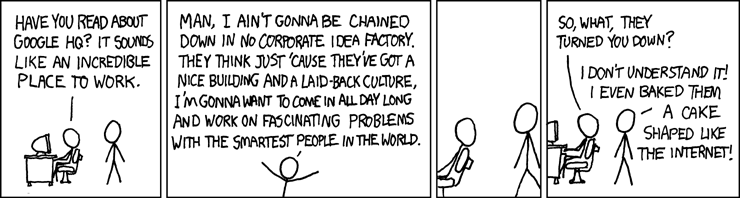
working for google
Comic-strip from xkcd.com - a webcomic of romance, sarcasm, math, and language, mainly because I like the idea of a internet-shaped cake.

Today's lecture started with a link to last week's discussion on realism and persuasion in popular science books. I introduced the class to "bob the balloon" who demonstrated, in a very hands on way, Newton's Third of Motion.

We then, more seriously, we looked through some science website before discussing topics of authority, access and the history of hypertext. I asked the class to think about what elements of a website make it appear trustworthy. Examples included: how high it was on google-searches, whether it had commenting, linked to other rebutable sites, had advertising on it, had been updated recently, seemed big and well designed. Of course, we can be fooled by many of these, the pregnant man website I promised to link to is here.

The second half was a group activity where I asked people to design a site for a (hypothetical) telecommunications gallery at the Science Museum. We had some great ideas; interfaces based on history of mobile phones, various styles of virtual tour, many different ideas about involving texting visitors and ways of using 3G or VOIP technology to get people in the gallery and outside to interact.

Popular Science

We started the session asking what is popular science, looking at some titles and considering whether we thought they were popular science or not. We then moved on to the broader question of what does popular science mean? What does the content popular science, indeed it's very existence, say about the cultural role of science?

Baudouin Jurdant suggests popular science can be considered as the "autobiography of science". Written mainly by scientists it articulates a public face of both scientific content and practise. This issue was largely discussed in the context of boundary work, we the class close analysis of an extract from this book; looking at where the writers construct and/or apply boundaries between science and an other.

We had a good student point raised about half way through. It was suggested that it was ironic I was talking so much about boundaries, when popular science was about acting as a bridge/ point of translation between science and the public. I agree, but... popular science can both aim to bring such groups together and act to separate them at the same time (we shouldn't imagine social actions are consistent). Last term Sarah probably mentioned a paper by Stephen Hiltgarter (see reading list). This argues that all popularised science, be it in book form or something like the Dana center, emphasises the difference between the public and science. The very existence of popularised science suggests the need for some special translation between science and society and so acts to emphasis the gaps between them. It might also be worth reading this paper by Massimiano Bucchi.

I also mentioned the problematic status of popular science books in terms of their claims to reality; a topic we'll pick up on next week. Baudouin Jurdant argues that much of the status of science is constructed by not being literature; science is special because it has a stronger (empirical) link to reality than simply text. Jurdant suggests that popular science is a rather problematic genre; textually communicating something that is by definition extra-literary. I suggested popular science books have to find ways in text to be as persuasive as visual or physical demonstrations, and we investigated this in some popular science books I'd taken out of the library

Anyone looking at popular science books as an essay topic should read the papers in the journal Public Understanding of Science by Jon Turney and Baudouin Jurdant. You can access them electronically from college. This is in addition to this week's reading, also by Turney, which is on webCT.

Class 15: Science in museums

Continuing our series of classes on the media of science communication, today we discussed - and experienced - science as it is presented in museums. While your handout (on WebCT) and the reading for this week (chapter 8 of Gregory and Miller 1998) give you some idea of the history of museums, helping us to understand the background to the format and the development of science centres, in our visit to the Science Museum we tried to concentrate on questions of exhibitions as constructed spaces.

We looked round two galleries: Making of the Modern World (ground floor), and Energy - fuelling the future (2nd floor). (Note that both have extensive websites attached to them, which can be used independently of the galleries - an interesting development in itself.) The galleries use very different styles, at least at first glance: MMW is object-heavy; while Energy contains very few objects but lots of computer-based interactives. We tried not to simply experience the galleries as a given - as we often do when wandering around museums - but to think critically about the effects they had and how these were created. In particular we considered what audience the gallery was designed for, how it was structured and laid out (and why), and how science was presented. In other words, we thought about the galleries as made for a particular purpose.

Opinion differed on both galleries: to some, Energy was 'gimmicky' while MMW was overwhelming in the mass of objects it presented. In our discussion afterwards, we touched on funding (how often are galleries updated, and where does the money come from?), purpose (are science museums there to present history, highlight contemporary science, or help people learn for themselves?), and the differences between visiting a science museum and an art gallery.

One final thought that we didn't get chance to discuss: should controversial science be presented in museums, and how could this be done?

Class 14: Documentaries

This week's class was given by a guest lecturer - Bob Sternberg from the Science Communication Group. We were given a whirlwind tour of TV documentary over the last century, from the 1920s Nanook of the North, through the different forms that emerged in the '60s with the introduction of new technology, to the mixes of different approaches often found in science documentary today.

We heard about four basic types of documentary: expository (where an argument is followed through), observational ('fly on the wall'), interactive (or interventionist, making use of interviews), and finally a reflexive form that acknowledges the constructed nature of the reality a documentary presents.

Bob left us thinking about how all documentary actually creates the 'reality' that we are presented with. This is a key idea that we'll be considering over the next few weeks as we look at other media for science communication. The close analytical work we started doing today - asking how a particular effect is created, who has done it, and why - will be repeated on other media such as museums, websites, and science books.

Bob's handout, and one from us giving some extra advice on assignment four, are both available on WebCT.

Class 13: presentations

Seeing as the students provided the content today, there isn't much for me to report.

But thanks to everbody for their great presentations - I don't think I've seen a year with such a great collection of props! Special thanks to those who agreed to attend outside of time-tabled hours so we could fit you all in. Thanks also to Giskin for helping us mark.

Class 12: Speaking on science

Today was an informal class designed to help you prepare for the assignments next week. We discussed some of the places in which science is spoken about - coming up with a surprising range, from pubs to the radio. Next came some personal top tips for speaking: the power of pauses and preparation, being a lighthouse, signposting, and using comedy, amongst others. Much of what was said is repeated on the class handout, now on WebCT.

You then got a chance to try out speaking at the front of class and to get some feedback. Overall themes were probably a need for volume, being careful about body language, and avoiding 'um's and 'er's as much as possible.

Next week you are expected to come to at least one hour (out of four) in order to give your talk, give feedback to someone else, and to support your colleagues. Check your inboxes for your time slot!

class 11: rhetoric

Although today's lecture was officially entitled "rhetoric" we spent a lot of it talking about coursework. You can now download the assignment 3 details on WebCT. Also please note that Humanities is now level three of Sherfield, not Mech Eng or level 5.

My focus on coursework was party because there are other humanities courses where you learn about rhetoric, such as the Saying True Things UG module, or the MSc in Science Communication. What I emphasised today was that much of science communication (including technical scientific communication) is about persuasion, or at least we can read it as such.

I also talked about Fahrenstock's focus on the way the audience of a piece effects the content, as well as suggesting the idea that the medium itself might "make" the message. The wikipedia entry on rhetoric might give you some further overview of the academic field, and there is a short bibliograpahy in the reading list, to which I'd like to add this:

  • Prelli, L (2001) Topical Perspective and the Rhetorical Grounds for Practical Reason in Arguments About Science, in Stocklmayer, S et al (eds) Science Communication in Theory and Practice (London, Kluwer) pp 63-82.

Despite my link to wikipedia above, I did also emphasise that we expect you to read more than what is on the web for your assignments. Although wikipedia and similar resources might be useful to get a first-glance hold of a topic (in fact, it's pretty good on science studies), it would not normally be appropriate to cite it in an essay. Wikipedia is, as members of the class mentioned, "policed". But this not the same as peer review.

Like lecture notes, dictionary definitions and most encylopedia entries, use it to get an idea of a topic but don't cite it in coursework. If you have any questions about using a particular source or want advice on further reading just ask. Normally the best place to start is the bibliogrpahy of the textbook and our reading list (including bibliographies in the books we suggest).

class 10: Science in Fiction


We started the class talking about this episode of Buffy the Vampire Slayer. We then discussed some of the symbols of science and technology suggested by the piece, before going through some more general issues of science and fiction. I also touched on narrative, although we'll talk about that issue more next term.

I mentioned David Kirby's work on "scientists on set", and I've put a link to his paper up on WebCT which is well worth reading if you are thinking about writing an essay on the topic.

Some other links to things I referenced in class:

  • Jon Turney's book Frankenstein's Footsteps. It's also worth looking up this book, although I forgot to mention it in class.
  • A definition of slash fiction (warning, may offend) - I don't think I made the link between fan fiction and internet communities as clearly as I should have. Fan fiction (including slash) existed before the web, but much of it is now published there. Wikipedia cites 1993 as when the first slash mailing list started.
  • Harold Rheingold's book (electronic version) on early internet based communication.
  • The "Buffy Studies" online journal.

The hands in the photo above are Willow's, from when she goes evil (Buffy nerds can try to work out which episode).

Session 9: risk (and intro to science policy)

We started with a debate, asking whether scientists are the best people to make decisions about science policy. If anyone wants to continue/ join this (with ideas on why scientists should or should not be the people to make policy decisions over science) we can start a thread in the comments to this post.

In terms of lecture content, we went through some key ideas in science policy and gave a brief overview of the topic of risk, especially issues of risk reporting in the media. All of this is covered in the handout (see WebCT). If anyone missed the class, read the chapter on "The ABC of Risk" in Gregory & Miller.

If anyone was particularly inspired by the topic of risk, Les Levidow is talking about GM issues at UCL this evening, details here.

I'm sorry if today was a bit rushed, I stupidly planned for a double session. I'm going to turn the activity we didn't get a chance to do (on sensationalism) into a blog entry - watch this space.

Class 8: thanks for your presentations

Just to say well done on your presentations earlier - I thought they were fantastic. If we'd had more time we could have discussed the pros and cons of the mechanisms and how well they fitted the different situations; as it is, you'll have to think about those things yourselves. (The info sheets are up on WebCT if anyone wants more details.)

Particularly well done for being creative with the mechanisms. These are not hard and fast processes, just as they are not a comprehensive list. Feel free to mix and match and to bend the formats when you come to do your assignments - just as long as you show why you're doing that.

That was your last class with me until after Christmas, so unless you're coming to Dana next week (I'll email those who are with more details) I'll see you then!

Class 8: Dialogue for policy

If the public are knowledgable and capable in dealing with science, then why shouldn't we involve them in science policy? And how could we do this?

These were the big questions of today's class. The work of critical authors - and the fact that we live in a democracy, and that millions of pounds of taxpayer's money goes to pay for public science - points us towards the need to engage publics in the science policy process. What this means in practice, we seemed to decide, varies from case to case.

A key point in solidifying these arguments was the 2000 House of Lords Third Report on Science and Society, which argued that "...direct dialogue with the public should move from being an optional add-on to science-based policy-making and to the activities of research organisations and learned institutions, and should become a normal and integral part of the process." A few years later, Demos argued that this dialogue should move 'upstream', to early in a technology's development, rather than just being tacked on at the end.

There are lots of ways of doing this. Participation mechanisms vary from e-consultation to consensus conferences to science shops to small group deliberations. The important thing is to fit the mechanism to the situation and to be clear about the aims and outcomes. As the GM Nation? debate proved, people rapidly lose patience with being engaged merely for PR purposes...

Class 6: Understanding Science

What is science? It looks like there are no easy answers. We came up with a range of descriptions, from 'falsification' to 'furthering humanity's endeavours'. We're not the only ones to struggle for a definition: philosophers and scientists have been trying to agree on a good one since science began. Having talked to people with some experience of working in science, we might start to see a reason for this. People's experiences - in UROP or YII - can be very different.

But one thing that did seem to be important in all of their experiences was community. Scientists - usually - work in groups or in close contact with one another. Sociologists of science Bruno Latour and Steve Woolgar, and the philosopher Thomas Kuhn, also saw science as a social process. Trust is necessary and new scientists are 'socialised' into the processes and practices of science. But if science is like this it is a 'subjective' process, and science's authority in society rests on it being objective; the ultimate way of knowing. What does this mean for science?

We talked about the Science Wars (the fights that broke out between social constructivists and 'realist' scientists) and what all this might mean for us as communicators. It might help us in terms of content: perhaps it's more important for us to tell people about the process of science than its 'facts'? Ultimately I think it will help us be humble, as well - if science is liable to revision, contingent and based on trust then we should acknowledge this, along with the fact that there can be other forms of uncertain, trust-based knowledge.

What do you think?

Class 5: Considering the public and media effects

After concentrating on the production of news texts so far in the course, this week we turned our attention to their reception and consumption by audiences and publics. We started with a discussion about violent video games and the effects they might have: opinion was divided but most people thought that other factors (such as home background or upbringing) would also help define how games changed behaviour.

We then talked about two different models of the public: a 'deficit model' which was used in the more traditional PUS movement, and the public as active. Drawing on Wynne's 1991 paper (the set reading for this week), we described the importance of context in how science is recieved. These models will affect how we 'do' communication; we'll be talking more about that in a couple of weeks time.

Finally we talked briefly about effects research and the difficulties of doing it. The media may well be powerful but it's very hard to establish a causal connection between what's in the news and our attitudes, beliefs and knowledge. If anyone's interested further, you should check out McQuail (316.77 MAC on level 5 of Central Library).

If anyone's still having trouble accessing WebCT, you need to contact IC service desk (service.desk@imperial.ac.uk).

Your assignments should be back with you in two weeks time (the 20th).

And - by the way - the picture is of an empty vessel. Like the deficit model of the public...

Class 4: the media and the transformation of knowledge

In today's double session we looked at how scientific information changes as it moves between different kinds of publication. We started by looking at some extracts from places like Science, the BBC website, or the Science Museum's Antenna. Amazingly, we could spot what was from where - so good are we at picking up on the internal cues and signals that tell us whether something is textbook or news.

We had a brief overview of Fahnestock's analysis of the changes between scientific paper and 'popularisation': a shift in genre from forensic to epideictic; appeals to 'wonder' and 'application'; and an increase in certainty and in uniqueness. We also discussed news values - factors that media scholars think journalists use to decide what is newsworthy. After some analysis of newspaper cuttings, it looks like values such as negativity, relevance, personalisation, facticity, and threshold are importantant for science stories.

Good papers to read to support today's topics are Fahnestock 1986 (on WebCT) and Hilgartner 1990.

And finally we gave out Assignment 1, due next Monday 6th November. Students are to produce a press release based on one of the four science stories on WebCT. If you read the instructions carefully and remember what we've talked about in terms of newsworthiness and journalistic style, you'l be fine...

Comment or email us if you have any problems!

Class 3: intro to press releases

The central point of today's session was that to write a good press release you need to consider what would make a good news story. Reading through the advice from Tim Radford I handed out last week should help, as will some of the content Sarah's discussing next week.

In terms of the more "nuts and bolts" issues we covered today, you should remember the "pyramidal format" (i.e. that you can cut a news story from the bottom up) and the need to clearly state the "what, why, who where, when and how" of the story as soon as possible. We also did an activity with a news story I had added words to, aiming to edit it back into decent news language (you can read the proper full version here).

Next week, Sarah will handout the first assignment, which is due the following week and asks you to write a press release. I handed out a few example press releases in class, it's worth looking at some before you write your own. UCL have a good press release archive. It's also worth googling science-rich universities and checking out AlphaGalileo. This has a database of research news from all over Europe, but (unless you are a journalist) you won't be able to access "notes for editors" or embargoed press releases.

Any questions - leave a comment or email me.

Class 2: What is science? Anatomy of a newspaper

In this session we got our fingers dirty with newsprint and did a mini "content analysis" of science reporting in the British press.

Our rather rough piece of social research was inspired by a "proper" investigation, the Science Museum Media Monitor (details of this can be found on pages 118-119 of the reading). We finished up with a brief overview of formal definitions of science, information on this is in the handout.

The reading for next week is a short piece by Tim Radford, which gives some basic advice on how to approach science writing. Radford himself will be appearing at Imperial college on thursday, in a special event on popular science books - details here. This should be an interesting event and recommended to com'n sci students. You can read more about it on Jon Turney's science book blog.

We also introduced assignment four, if anyone has any questions about that, please email me (again, the handout is on WebCT).

Class 1: Introducing Communicating Science

Well, we've started! Our first class was 9th October at lunchtime and I think we got off to a good start. After some introductions (of Alice and Sarah) and some admin (the course notes and reading list are both online in WebCT, to which all students should now have access), we played a card game. Not poker (there was no gambling involved), but a kind of swap shop of statements about science, the public, and the media. We quickly discovered that we already disagree about some things. The statement 'Scientists may be experts in one field, but citizens can be experts too' seemed particularly contentious, with some loving it and others hating it. This is definitely an idea we'll be coming back to!

Then there was just time for a quick story. It was a tale of two reports and one department: the 1985
Royal Society report 'The public understanding of science' (which started off this latest wave of interest in communicating science); Imperial's very own Science Communication Group, started in 1991 by John Durant as part of the PUS movement; and the 2000 House of Lord's Third Report on Science and Society. Not a snappy title, but a key moment in the shift towards 'dialogue' in science communication. On which more soon...

Next week we start our survey of news media. Don't forget to do the reading for the second session before the class!

And finally, a quick QUESTION that we didn't have time for in class today: What do students want to get out of the course? We'd be interested to know so comment and tell us your thoughts...