Showing posts with label internet. Show all posts

session 17: the internet
working for google
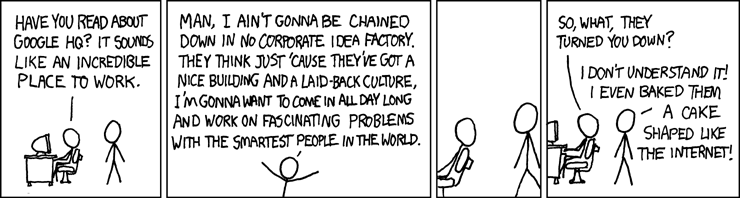
Comic-strip from xkcd.com - a webcomic of romance, sarcasm, math, and language, mainly because I like the idea of a internet-shaped cake.

Today's lecture started with a link to last week's discussion on realism and persuasion in popular science books. I introduced the class to "bob the balloon" who demonstrated, in a very hands on way, Newton's Third of Motion.

We then, more seriously, we looked through some science website before discussing topics of authority, access and the history of hypertext. I asked the class to think about what elements of a website make it appear trustworthy. Examples included: how high it was on google-searches, whether it had commenting, linked to other rebutable sites, had advertising on it, had been updated recently, seemed big and well designed. Of course, we can be fooled by many of these, the pregnant man website I promised to link to is here.

The second half was a group activity where I asked people to design a site for a (hypothetical) telecommunications gallery at the Science Museum. We had some great ideas; interfaces based on history of mobile phones, various styles of virtual tour, many different ideas about involving texting visitors and ways of using 3G or VOIP technology to get people in the gallery and outside to interact.

class 10: Science in Fiction


We started the class talking about this episode of Buffy the Vampire Slayer. We then discussed some of the symbols of science and technology suggested by the piece, before going through some more general issues of science and fiction. I also touched on narrative, although we'll talk about that issue more next term.

I mentioned David Kirby's work on "scientists on set", and I've put a link to his paper up on WebCT which is well worth reading if you are thinking about writing an essay on the topic.

Some other links to things I referenced in class:

  • Jon Turney's book Frankenstein's Footsteps. It's also worth looking up this book, although I forgot to mention it in class.
  • A definition of slash fiction (warning, may offend) - I don't think I made the link between fan fiction and internet communities as clearly as I should have. Fan fiction (including slash) existed before the web, but much of it is now published there. Wikipedia cites 1993 as when the first slash mailing list started.
  • Harold Rheingold's book (electronic version) on early internet based communication.
  • The "Buffy Studies" online journal.

The hands in the photo above are Willow's, from when she goes evil (Buffy nerds can try to work out which episode).

the guardian on web 2.0

Those of you interested in the web as a communication medium may want to check out the Guardian Magazine's feature on Web 2.0 from this weekend. The interested but ultimately cynical John Lanchester writes the main story surveying recent developments in cyberspace (do people still call it that?) and there are interviews with the key figures involved - the people who brought us Wikipedia (fantastic - but don't quote it in essays...), MySpace, YouTube and all the rest of it.

Lanchester reckons its all clever stuff but is doubtful that sitting at a computer can ever replace face to face human interaction. What do you think?

And if you get bored of techy stuff - it can happen - then they also have a nice looking recipe for yammy gingerbread...